

About the A9N Project
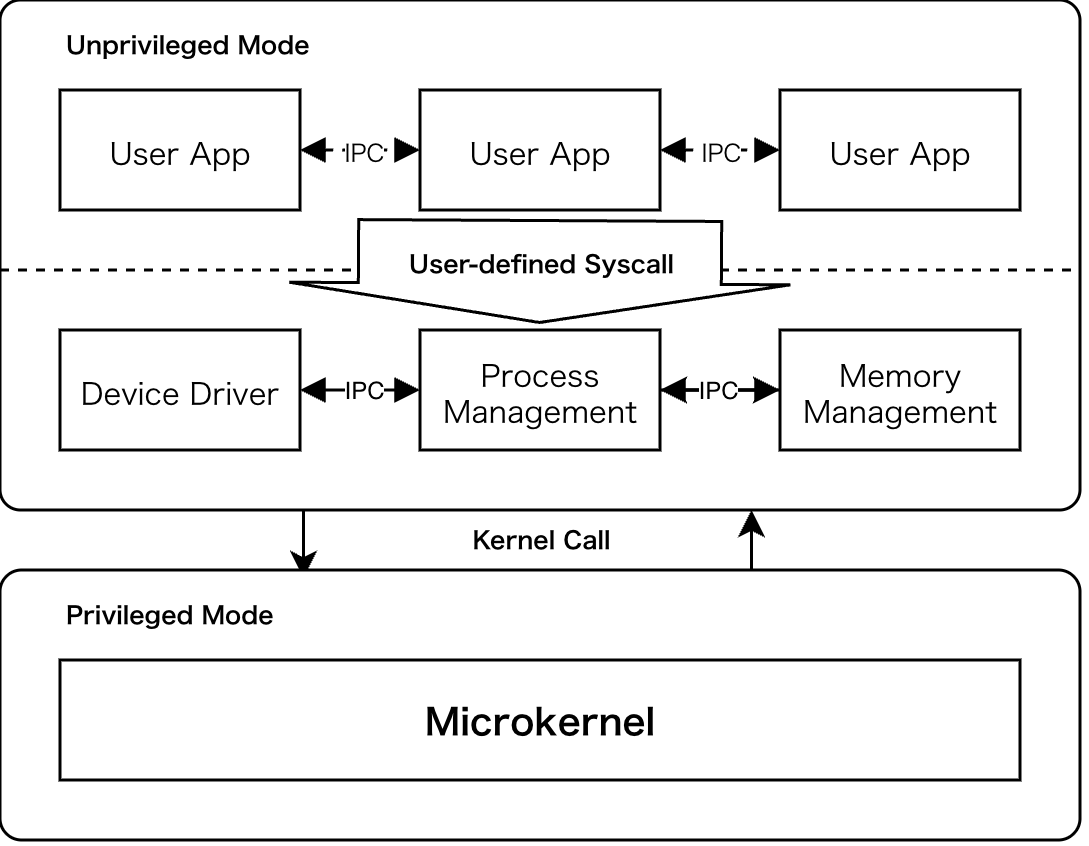
Microkernel
A Microkernel limits the kernel to mechanisms such as memory protection, scheduling, and IPC (inter-process communication). Drivers and filesystems run as separate user-space processes and communicate through IPC.[1][2]
Capabilities and the Object-Capability Model
A capability is an unforgeable reference that identifies an object and grants authority to use it. In the Object-Capability Model, objects interact through these references and delegate authority by passing them.[3][4]
The Principle of Least Privilege (PoLP) calls for granting only the authority needed for a task. In A9N, user-space code chooses which capabilities to give each service, limiting its authority.[5][6][7]
A9N uses the Take-Grant Model for authority delegation and keeps capabilities under kernel control. Operations require a capability reachable by the calling process and the necessary rights; knowing a descriptor’s numeric value alone grants no authority.[7][8]
A system built on A9N
A9N Microkernel handles execution, protection, and IPC. User-space services provide drivers, filesystems, and networking, connected through capabilities and IPC.[9]
Nanami is an OS built this way. Nun provides Rust startup support, while SPENCER assembles the kernel, boot software, and OS into a bootable image.[9]
Developer
References
- Jochen Liedtke. On μ-Kernel Construction. SOSP ’95, pp. 237–250, 1995. §2.
- Per Brinch Hansen. The nucleus of a multiprogramming system. Communications of the ACM 13(4), pp. 238–241, 250, 1970.
- Jack B. Dennis and Earl C. Van Horn. Programming Semantics for Multiprogrammed Computations. Communications of the ACM 9(3), pp. 143–155, 1966.
- Mark S. Miller. Robust Composition: Towards a Unified Approach to Access Control and Concurrency Control. PhD dissertation, Johns Hopkins University, 2006. §§9.1–9.2.
- Jerome H. Saltzer and Michael D. Schroeder. The Protection of Information in Computer Systems. Proceedings of the IEEE 63(9), pp. 1278–1308, 1975. §I.A.3(f).
- R. Levin, E. Cohen, W. Corwin, F. Pollack, and W. Wulf. Policy/mechanism separation in Hydra. SOSP ’75, pp. 132–140, 1975. §§1, 4.
- A9N Project. A9N Manual: Capability. Source revision 02951a4.
- Richard J. Lipton and Lawrence Snyder. A Linear Time Algorithm for Deciding Subject Security. Journal of the ACM 24(3), pp. 455–464, 1977.
- A9N Project. Nanami OS: Architecture Overview. Source revision 5a2da38.