

A9N Projectについて
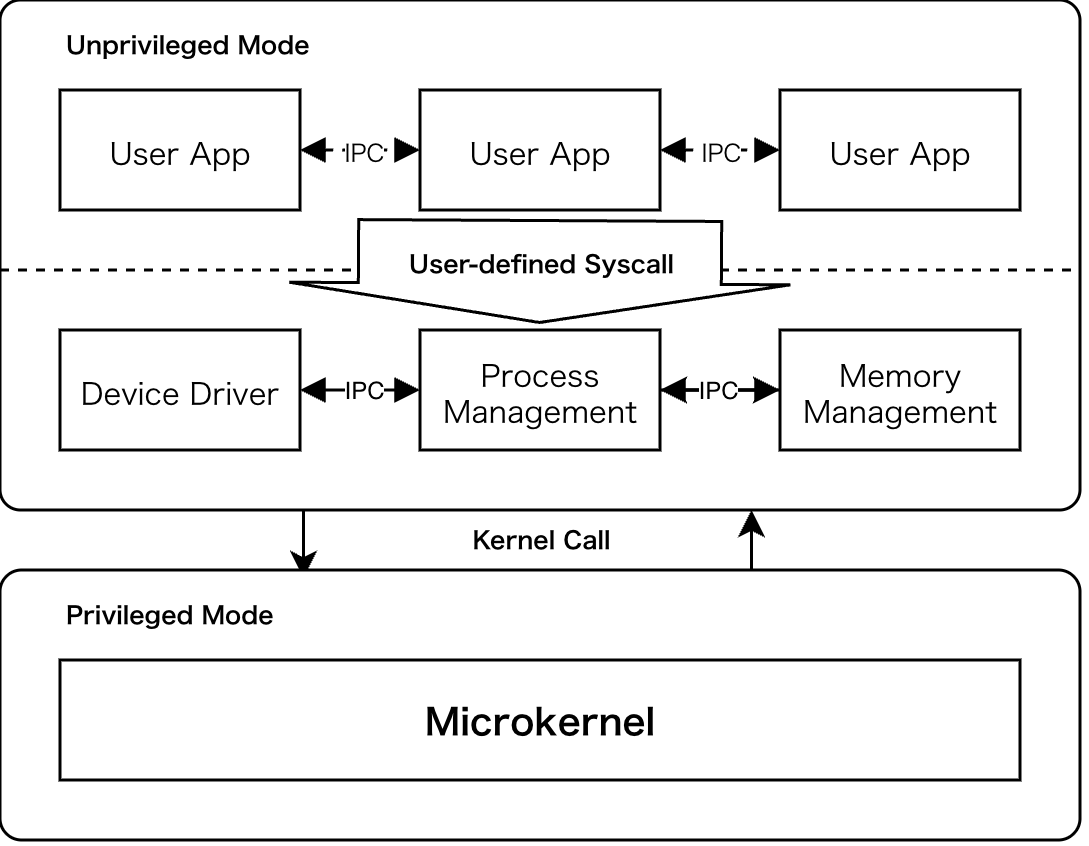
Microkernel
Microkernelはメモリ空間の保護,スケジューリング,IPC(プロセス間通信)などにカーネルの役割を絞る設計です.ドライバやファイルシステムはユーザー空間の別プロセスとして実装し,IPCで連携します.[1][2]
CapabilityとObject-Capability Model
Capabilityは操作対象と権限を表す,偽造できない参照です.Object-Capability Modelではその参照を通じてオブジェクトを操作し,参照の受け渡しで権限を委譲します.[3][4]
最小権限の原則(PoLP)は,仕事に必要な権限だけを与える原則です.A9Nでは,サービスに渡すCapabilityをユーザー空間で選び,権限を制限できます.[5][6][7]
A9Nは権限の委譲にTake-Grant Modelを採用し,Capabilityをカーネルで管理します.プロセスから到達できるCapabilityとその権限を検査するため,識別子の数値を知るだけでは操作権限を得られません.[7][8]
A9Nをコアとするシステム
A9N Microkernelが実行・保護・IPCを担い,ユーザー空間のサービスがドライバ,ファイルシステム,ネットワークを提供します.各サービスはCapabilityとIPCで接続されます.[9]
Nanamiはこの構成のOSです.NunがRustの起動処理を提供し,SPENCERがカーネル,ブートローダ,OSを起動イメージにまとめます.[9]
開発者
参考文献
- Jochen Liedtke. On μ-Kernel Construction. SOSP ’95, pp. 237–250, 1995. §2.
- Per Brinch Hansen. The nucleus of a multiprogramming system. Communications of the ACM 13(4), pp. 238–241, 250, 1970.
- Jack B. Dennis and Earl C. Van Horn. Programming Semantics for Multiprogrammed Computations. Communications of the ACM 9(3), pp. 143–155, 1966.
- Mark S. Miller. Robust Composition: Towards a Unified Approach to Access Control and Concurrency Control. PhD dissertation, Johns Hopkins University, 2006. §§9.1–9.2.
- Jerome H. Saltzer and Michael D. Schroeder. The Protection of Information in Computer Systems. Proceedings of the IEEE 63(9), pp. 1278–1308, 1975. §I.A.3(f).
- R. Levin, E. Cohen, W. Corwin, F. Pollack, and W. Wulf. Policy/mechanism separation in Hydra. SOSP ’75, pp. 132–140, 1975. §§1, 4.
- A9N Project. A9N Manual: Capability. Source revision 02951a4.
- Richard J. Lipton and Lawrence Snyder. A Linear Time Algorithm for Deciding Subject Security. Journal of the ACM 24(3), pp. 455–464, 1977.
- A9N Project. Nanami OS: Architecture Overview. Source revision 5a2da38.