
User-space Operating System
Nanami OS
An experimental user-space OS on the A9N Microkernel.
Features
- Alpha service for process and memory management
- AHCI, virtio, and USB xHCI drivers
- ext2, IPv4, and POSIX services
- Honoka desktop environment and native applications
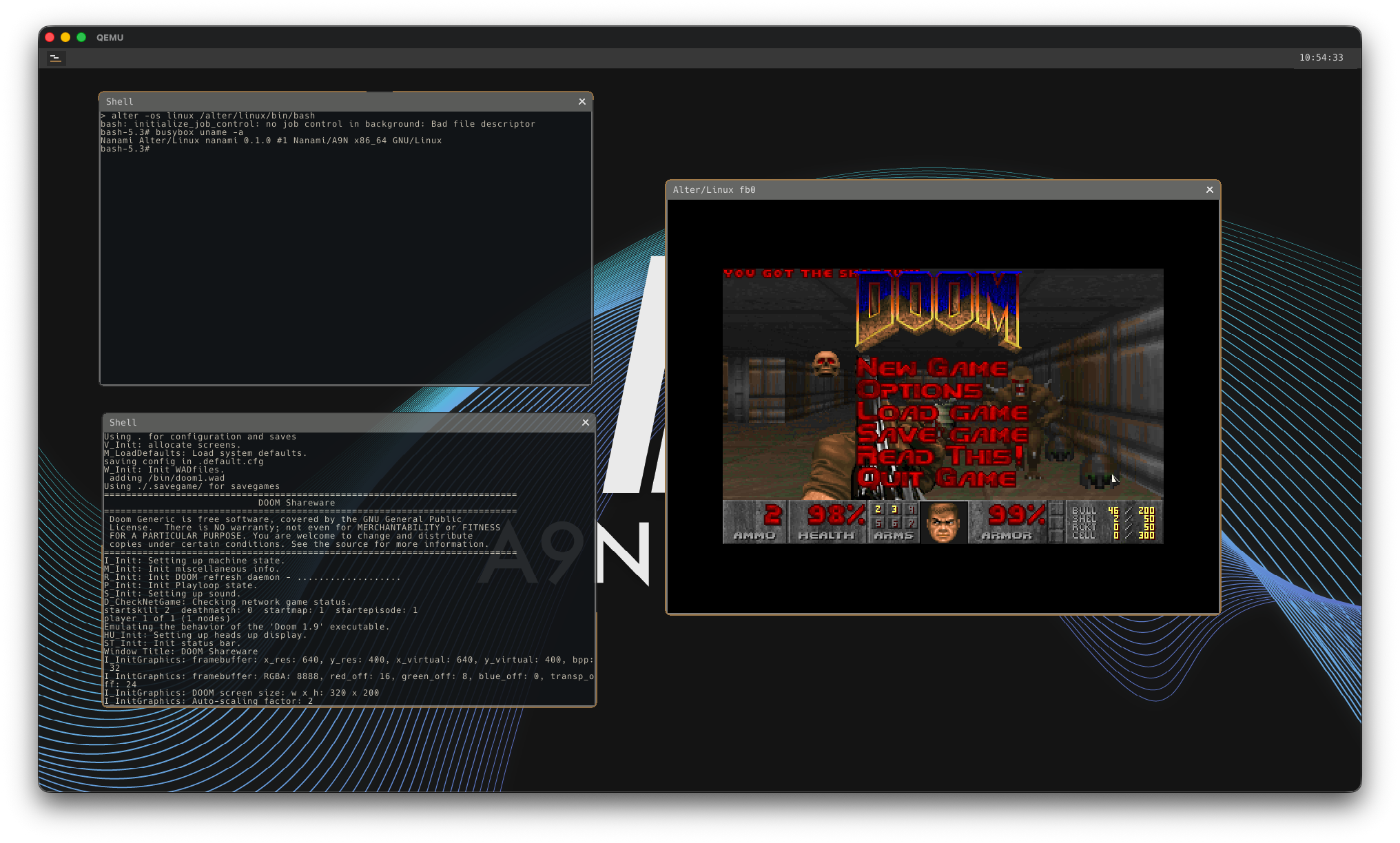
- Linux and FreeBSD binary execution through Alter/
- Rust and C++ application SDKs
An OS composed in user space
Nanami implements drivers, filesystems, networking, graphics, and ABI compatibility as separate user processes. Alpha, its process and memory management service, manages physical resources, process creation, address spaces, and service discovery. OS-specific policies are built above the A9N Microkernel.
Synchronous IPC carries control requests. Shared memory, DMA buffers, ring buffers, and notifications serve higher-volume data paths. Drivers and subsystem servers run independently of Alpha, allowing each subsystem to use a data-transfer path suited to its workload.
Resource domains and service exchange
Multiple Alpha instances can be started with explicitly partitioned memory budgets and capabilities. Each instance has its own process management and service namespace. Imports are limited to supported stateless control services, with individual connections exposed rather than the parent’s entire resource set or registry.
Managed services can cooperatively replace their provider process while retaining their public name and client endpoint. Accepted requests finish before receive authority moves to the successor; ordinary requests continue to use direct IPC. Additional profiles retain opaque shared buffers and pending-work notifications across exchange.
Exchange requires cooperation from a compatible service. It does not provide arbitrary application-state or device-state migration, nor automatic recovery from an unresponsive provider.
Storage, networking, and devices
A user-space driver manager selects platform drivers. AHCI and virtio block devices, virtio networking, USB xHCI, timers, input, and display are handled by separate services. The ext2 filesystem runs above the block-device service and supplies file operations to applications and other services.
The network service implements DHCP, ARP, IPv4, ICMP, UDP, DNS, and TCP. Native applications and Alter/Linux sockets share this stack, allowing supported Linux tools such as ping to use Nanami’s own networking services.
The Honoka desktop
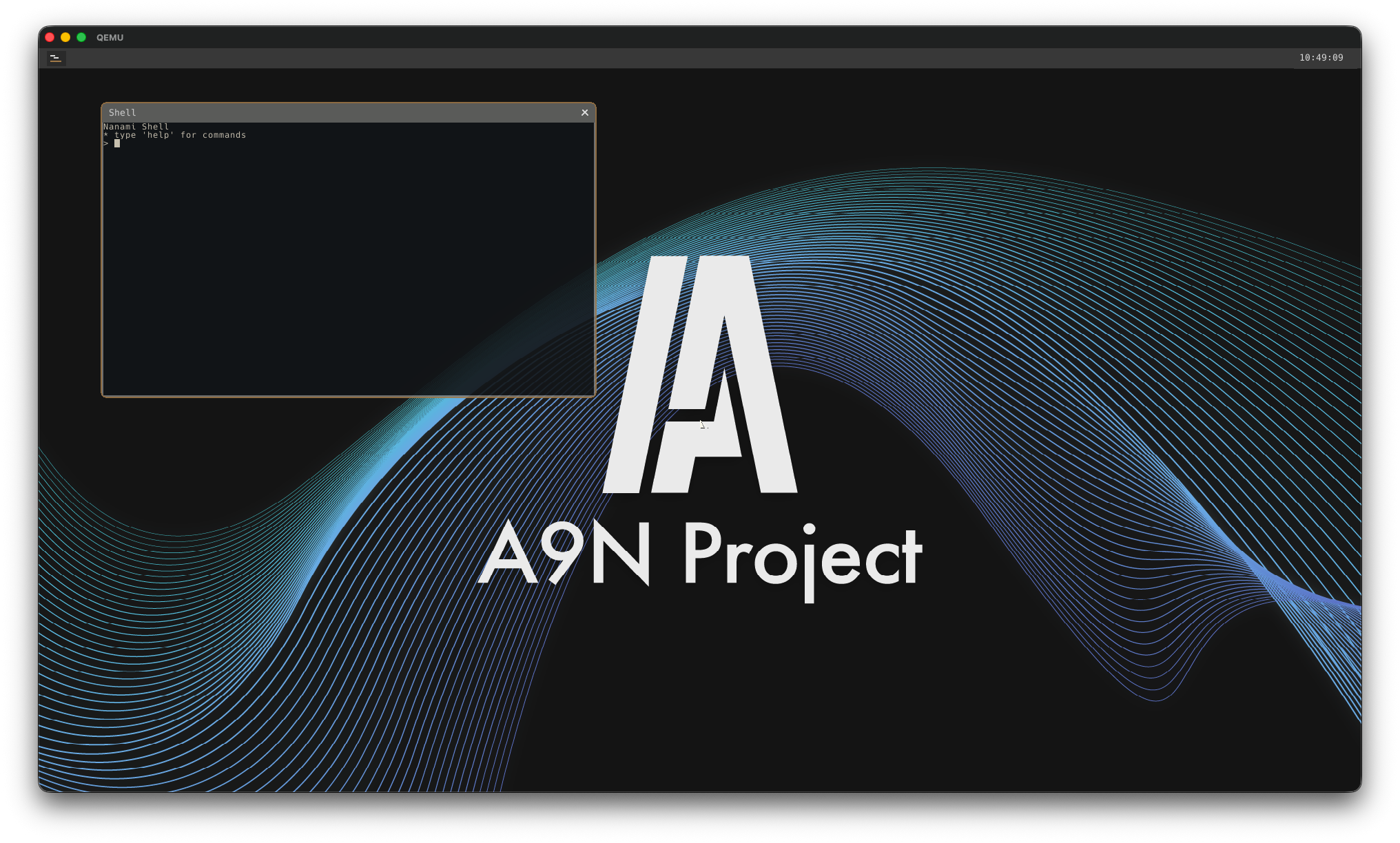
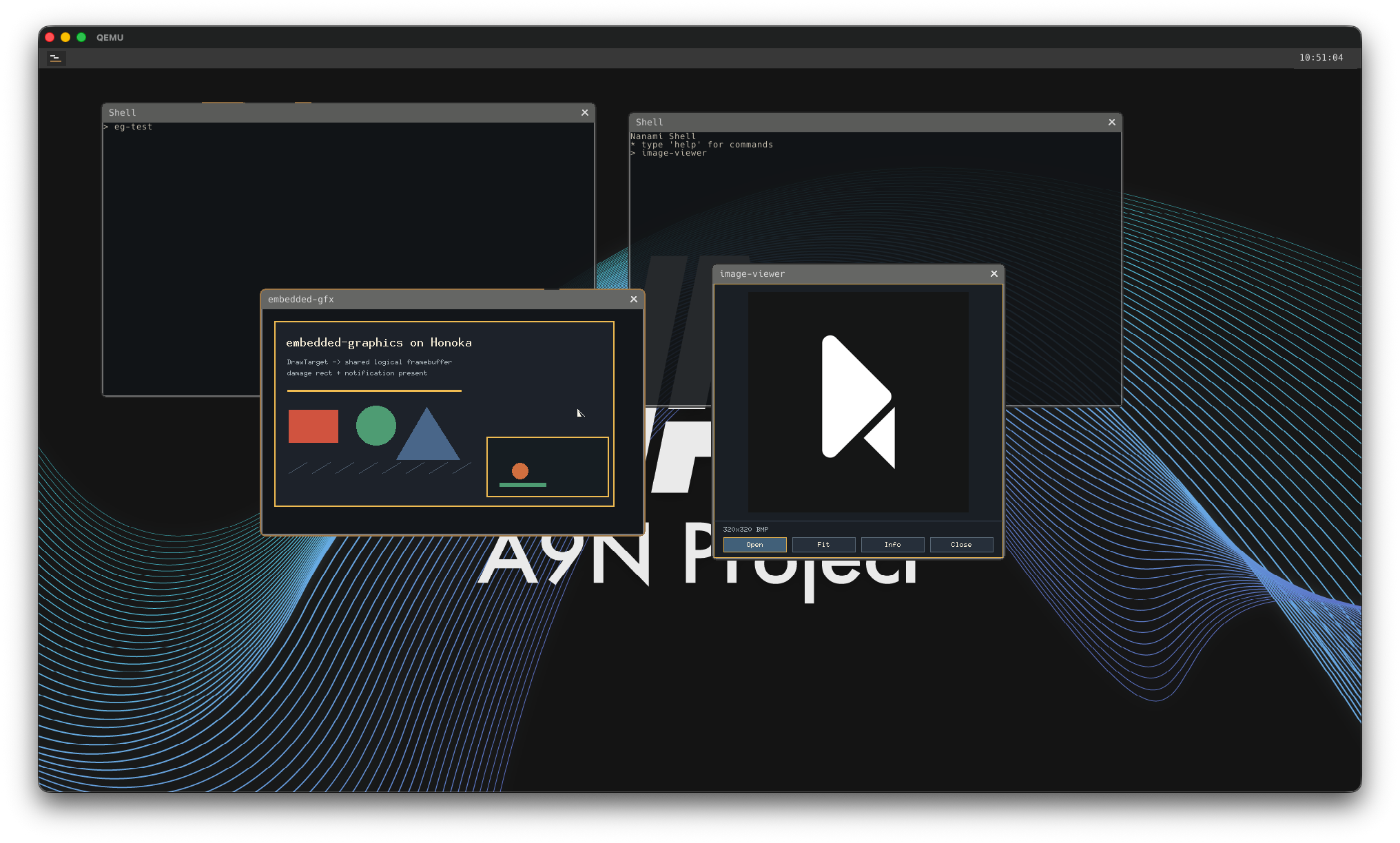
Honoka is Nanami’s compositor and window manager. It owns window decorations, transparency, focus, movement, cursor rendering, wallpaper, and themes. Applications draw into shared-memory window buffers and report damaged regions, separating application rendering from desktop composition.
A common display interface connects Honoka to supported native GPU drivers or an independent boot-framebuffer backend. The desktop hosts native applications such as the graphical shell and image viewer, as well as an X11 environment running through Alter/Linux inside a Honoka window.
OS ABI compatibility through Alter/
Alter/ reproduces the binary interfaces expected by Linux and FreeBSD applications in user space. It receives syscall faults from A9N and translates them into Nanami service requests. ABI-specific handlers can be replaced without changing the kernel or process management service.
Alter/Linux supports x86_64 and AArch64, with dynamic linking, process and thread management, signals, and sockets. On x86_64 it runs Tiny Core 17.1 userspace and an X11 environment inside Honoka. The shell, dynamic linker, and libc come from Tiny Core’s distribution, without a guest Linux kernel or hardware virtualization.
Compatibility is bounded by implemented syscalls and flags. Alter/FreeBSD targets x86_64 and does not support dynamic linking. Each personality’s support table records partial behavior and unsupported conditions as well as dispatched calls.
Service boundaries and shared interfaces
Process, file, terminal, and socket services are shared by native applications and ABI compatibility layers. nanami-uapi holds wire types and protocols, nanami-runtime supplies common runtime behavior, and nanami-client provides typed service calls. This separates service implementations from the interfaces their clients depend on.
Native Rust applications support x86_64 and AArch64; the freestanding C++ SDK targets x86_64. Boot-critical services, system services, and user-session programs have separate configuration. AArch64 is currently headless; its native timer, display, input, and network stack are not yet implemented.
Technical details
- Primary language
- Rust
- x86_64
- QEMU/UEFI and supported hardware
- AArch64
- QEMU virt/U-Boot, headless
- AArch64 limits
- No native timer, display, input, or network stack yet
- Runtime
- Nun (Rust)
- Status
- Active development; ABI and service protocols may change
- License
- MIT
- Source reference
- main ·
5a2da38↗
Screenshots