
Build / Image / Run
SPENCER
Build A9N, generate disk images, and run them with QEMU.
Features
- A9N, Nun, and bootloader builds
- UEFI and U-Boot images
- QEMU execution, SMP configuration, and GDB debugging
- External OS integration, including Nanami
A complete boot-image pipeline
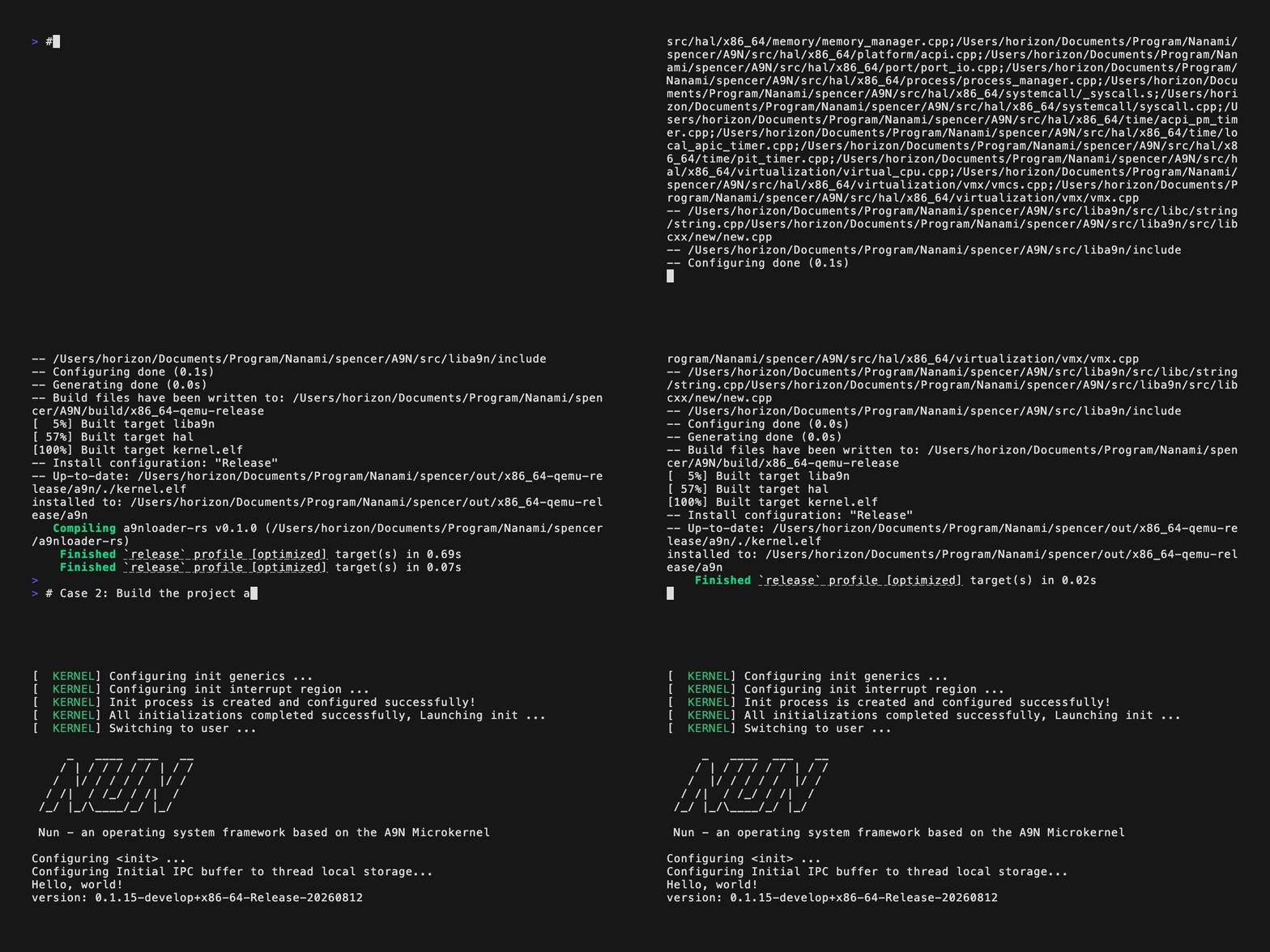
SPENCER builds the A9N Microkernel, a Nun-based OS payload, and architecture-appropriate boot software, then assembles them into a bootable disk image. It manages the combination of kernel, user program, and boot files as one system configuration.
x86_64 uses A9NLoader-rs and UEFI; AArch64 uses U-Boot. Artifacts are separated by architecture, platform, and Debug/Release profile, keeping the individual kernel and Init binaries alongside their final image.
QEMU and Raspberry Pi 4
The same tool manages QEMU execution, virtual CPU count, the kernel’s SMP configuration, hardware acceleration, and GDB connectivity. Kernel SMP support and QEMU CPU count remain separate settings; a multicore run without an SMP-enabled kernel is rejected.
For Raspberry Pi 4 Model B, SPENCER creates an SD-card image containing VideoCore firmware, the device tree, U-Boot, A9N, and Init. Firmware acquisition and U-Boot builds are included in the pipeline, supporting both emulator-based validation and physical-board boot composition.
Integration with external operating systems
The OS payload is not fixed to SPENCER’s sample. An external Cargo manifest, target definition, and executable can enter the same build and image pipeline. Nanami uses this integration boundary.
The external executable is installed directly as the image’s Init payload. An OS can retain its own source structure while SPENCER owns bootloader/kernel composition, artifact placement, and QEMU execution.
Technical details
- Commands
- cargo xtask
- Architectures
- x86_64, AArch64
- Platforms
- QEMU, Raspberry Pi 4 Model B
- Rust toolchain
- nightly-2026-03-25
- License
- MIT
- Source reference
- main ·
18b6127↗
Screenshots